Written by Arundhati Saraswatula, Oxford Collections Intern
The Rona was the yacht upon which Baron Ferdinand de Rothschild travelled across the world. She was a vessel of extraordinary decadence, used to entertain friends, politicians and royalty, and to satisfy curiosity about distant lands and peoples. Other Rothschild family members such as Nathaniel Mayer, Julie and Edmond owned or sailed yachts too, not just to travel but to compete in boating races, in Julie’s case, or to practice their photography skills abroad, in Nathaniel’s case.
Read on to find out more about the Rothschilds at sea, the stories their yachting adventures can tell about their lives and how we’ve preserved these histories here at Waddesdon Manor.
The Rona
The Rona was built in Glasgow in 1893-4 and was the largest sailing yacht of her time- comparable ones were those belonging to the Emperor of Russia and the Kaiser. She was 270 feet in length and weighed more than 1000 tons and was equipped with electric lighting and heating. In addition to being a grand feat of mechanics and engineering, she was decked out with a saloon (with a piano), a dining room (with 40 chairs), a boudoir (with a fireplace), 11 staterooms and a darkroom for developing photographs.
Ferdinand bought her in 1895 before he set sail for Marseilles, Algiers, Tunis, Sicily, Malta, Naples, Monte Carlo, and Cannes, ending in Nice on 17 February 1896. The photographs that were taken of, or bought as souvenirs, at the various historical and archaeological sites visited by Ferdinand, and of the yacht’s interiors, were all collected in leather-bound albums that are kept in Waddesdon Manor.
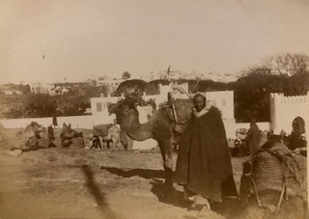
Market place, Tangiers. c. 1897
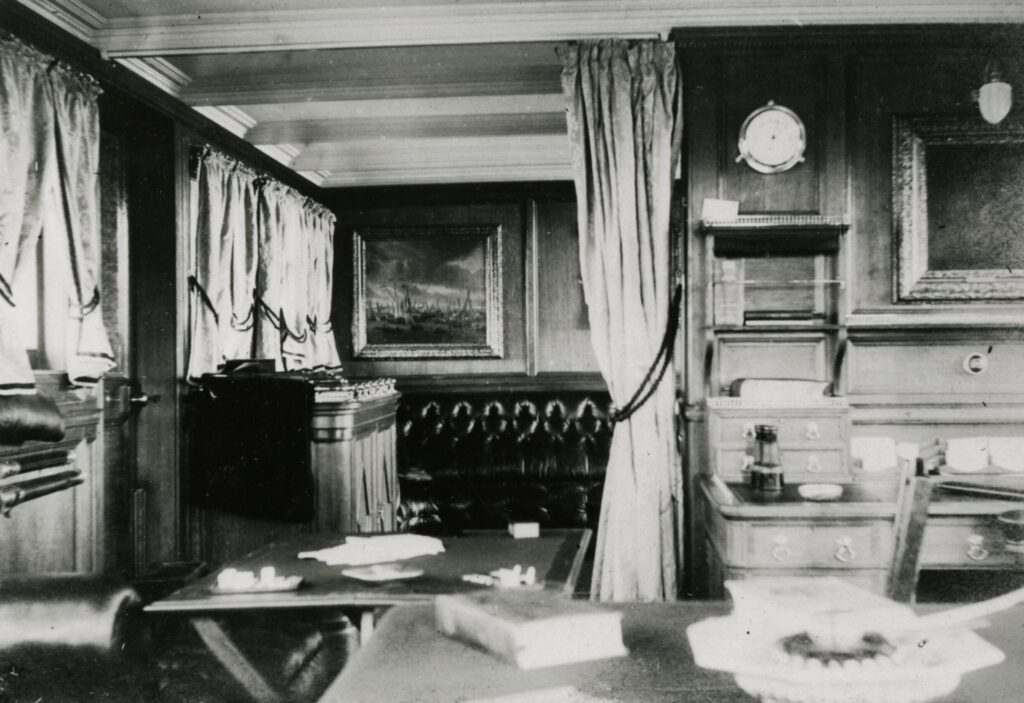
Rona deck saloon interior
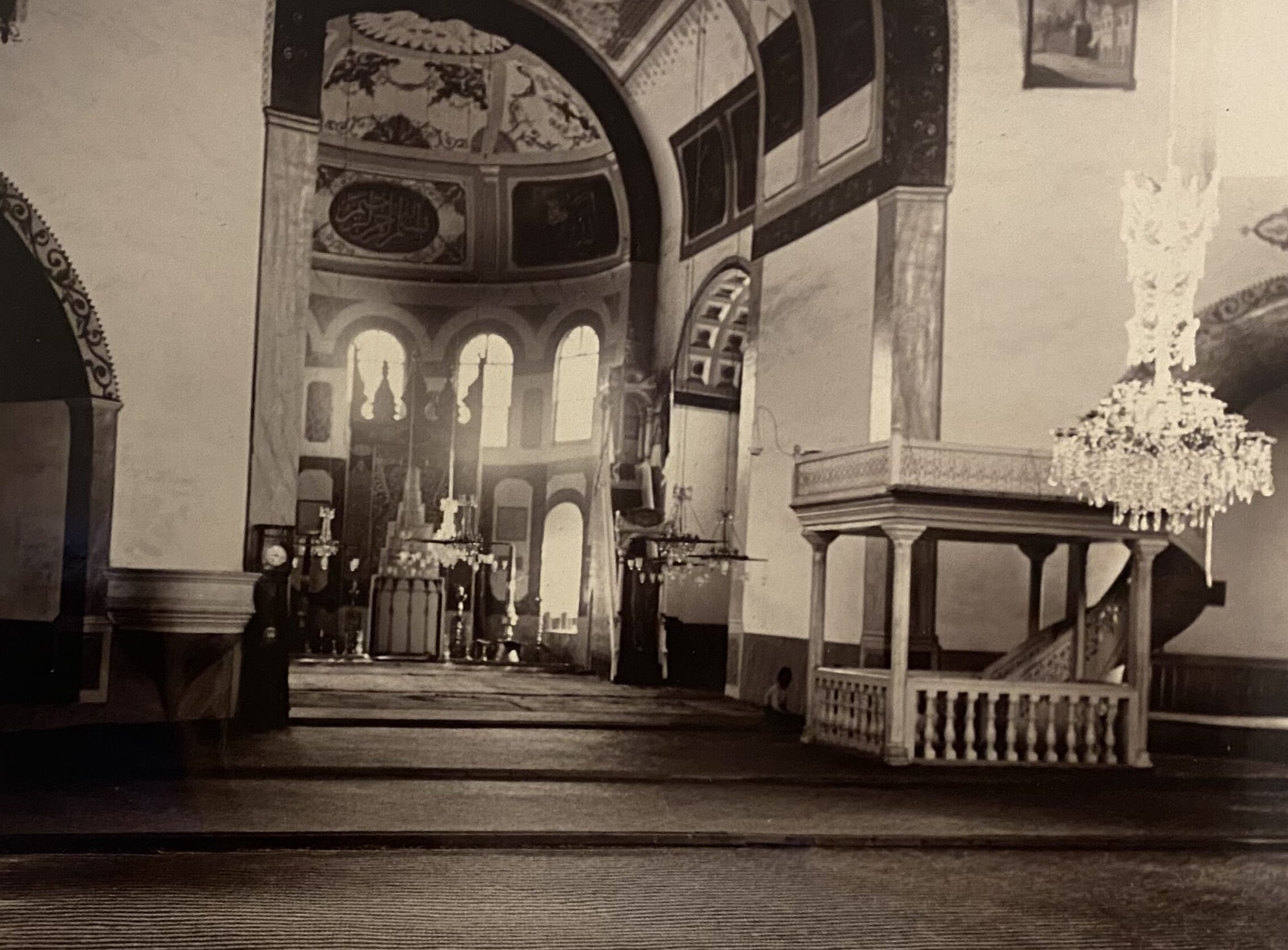
Interior of Mosque, Salonica (Thessaloniki), Jan 18th 1897
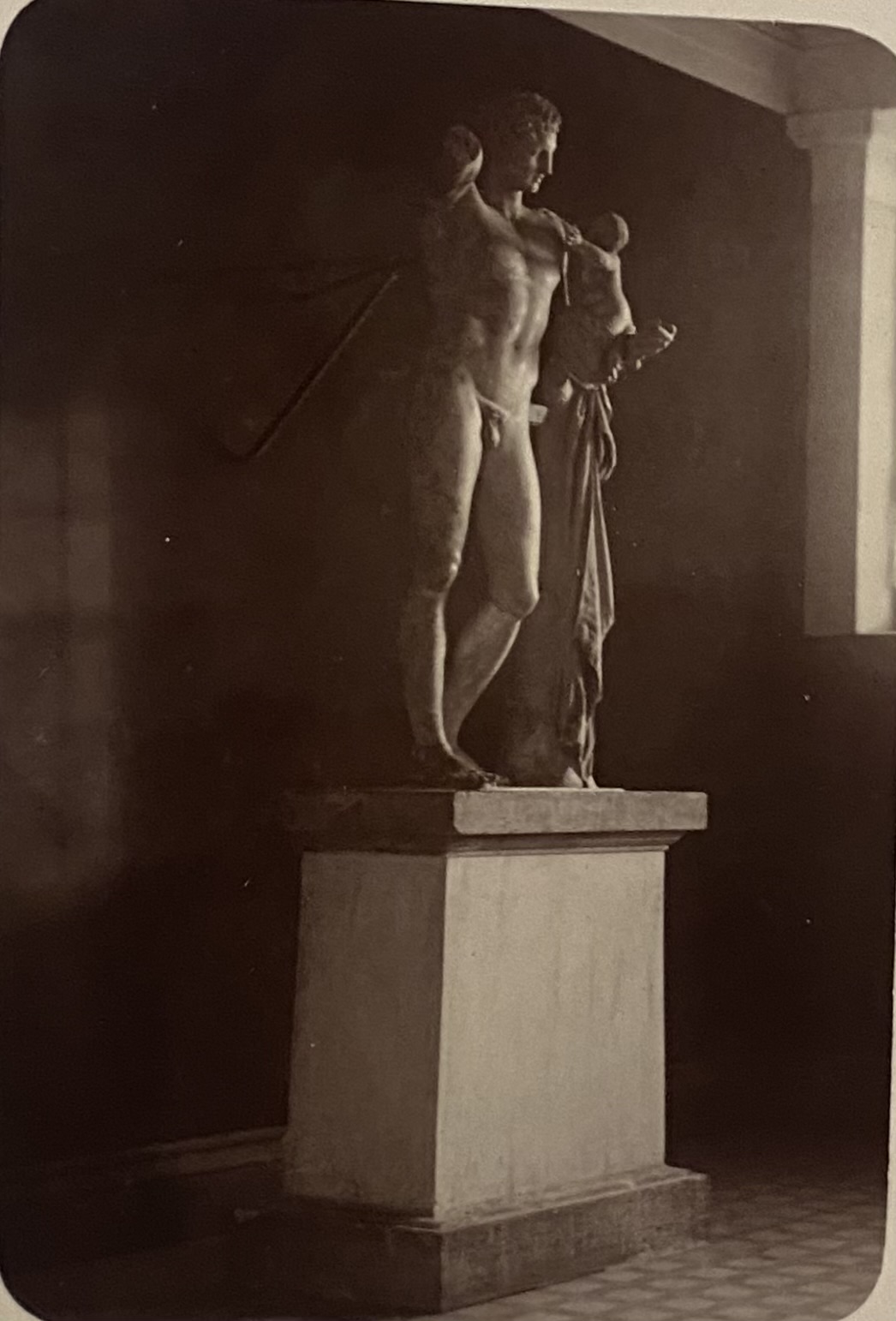
Hermes, Olympia, Jan 13th 1897
Who was aboard the Rona?
The Rona visitors’ book, currently on display in the Red Ante Room, contains signatures of all those who travelled with Ferdinand, including kings and queens, socialites, colonial administrators and politicians. Ferdinand entertained a wide variety of people on board the Rona, engaging in the same eclectic conversations that would have been taking place at Waddesdon manor. With both male and female passengers coming aboard, often from the highest echelons of society, taking a closer look at who exactly Ferdinand invited can tell us a lot about his life and times:
Arnold Morley – On board at Cowes, Aug 8th and Amsterdam Sept 14th 1897: Arnold Morley was a Liberal politician, serving under William Gladstone as Parliamentary secretary to the Treasury in 1886. Ferdinand himself was a Liberal candidate and later, a Liberal-Unionist, sitting as a member of parliament from 1885-1898. In 1897 when Morley was aboard the Rona with Ferdinand, they would have had much to talk (and disagree) about. Irish home rule and the viability of the British Empire would most likely have been hot topics of conversation between the two men.
Frederick Seymour – On board at Naples, Feb 15th 1898: Serving as a colonial administrator in various British colonies from 1842-1863, Frederick Seymour was the first Governor of British Colombia in Canada. He was in command during the Fraser Canyon Gold Rush in 1858, when miners struck gold and thousands of men flocked to British Colombia to stake their claim to the newly discovered riches. Though the Rothschilds were not involved in Canada, they did have a big part to play in gold trading in places like San Francisco, South Africa and New South Wales in Australia. It was Nathan Mayer Rothschild, founder of the English branch of the family (and Ferdinand’s grandfather), who made his fortunes through banking and dealing in gold bullion in the early 1800s but even in Ferdinand’s time 50 years later, the Rothschilds continued to play a leading role in new discoveries of gold being brought to the London market.
Lady Constance Butler – On board at Cowes, Aug 5th 1898: Constance Mary Butler was a fascinating figure who was an Anglo-Irish noblewoman, medical volunteer during World War One as well as a talented yachtswoman! The image below is her on the steam yacht Miranda captained by Lemon Cranfield and one of the most successful racing yachts in the country from 1880 to 1884. Butler was described as wearing ‘the most severely simple and workmanlife clothes’ when on a yacht while at the same time being one of the most beautiful socialites of her generation. She was a supporter of the Irish Republican cause and an antiquarian, meticulously transcribing medieval documents at Kilkenny Castle in Ireland into modern English.
Duchess Millicent Sutherland – On board at Dunrobin, Aug 30th 1898: Another fascinating personality aboard the Rona was the Scottish social reformer, author, playwright and society hostess, Millicent Leveson-Gower, Duchess of Sutherland. She enrolled at the French Red Cross in Paris in 1914 and formed her own ambulance unit, writing a memoir, Six Weeks at the War, after returning to England. She was likewise engaged in improving working lives in Staffordshire and encouraging the cottage industry (hand-made, home-based goods) in the Highlands. The photograph on the right was taken in 1898, the same year she visited Waddesdon Manor (3706).
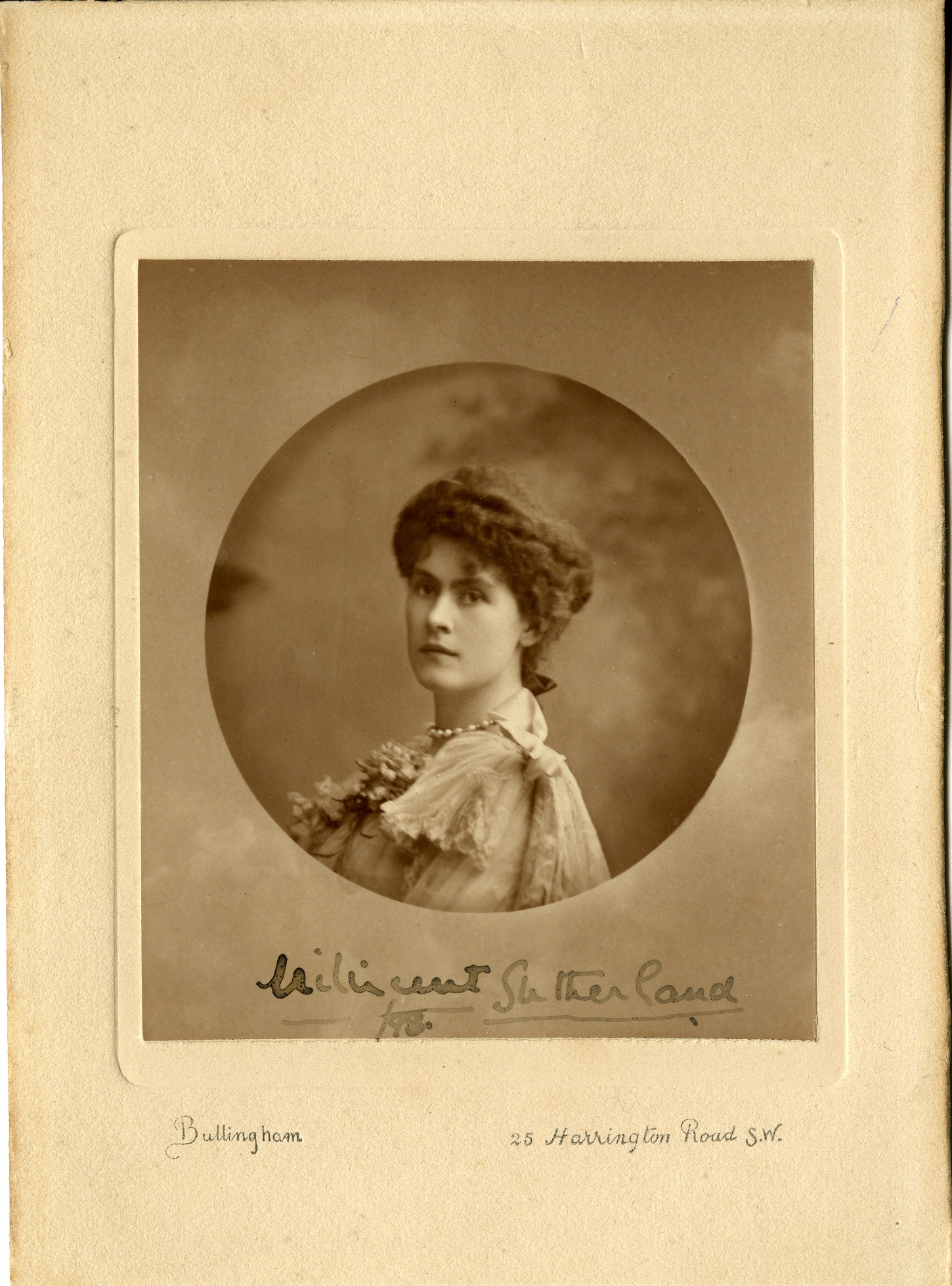
Duchess Millicent Sutherland
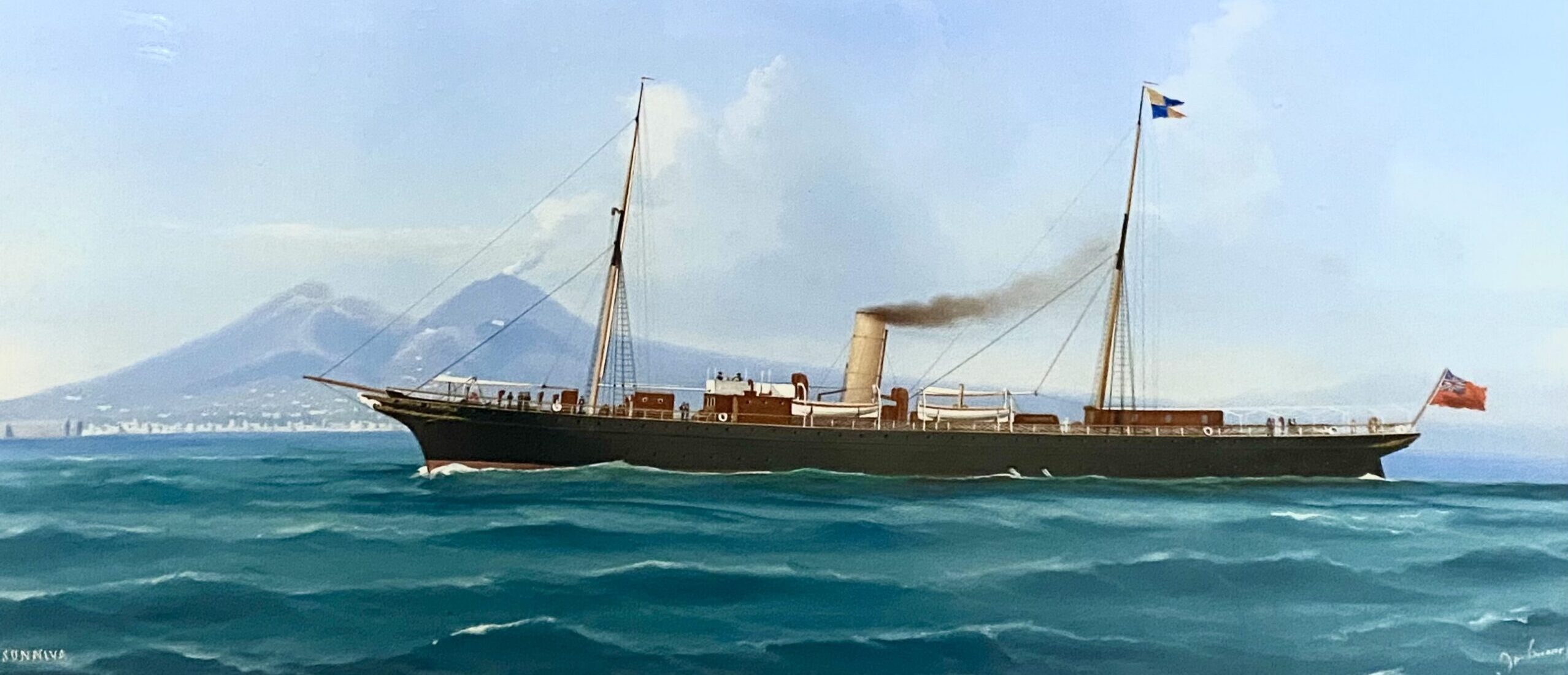
Ferdinand aboard the Saint Sunniva
The history of yachting in the Rothschild family is inexhaustibly interesting, made all the more so by the wealth of sources we have (and are still uncovering) about their travels. A recently rediscovered account by Ferdinand of his trips aboard Saint Sunniva from December 28th 1893 to February 3rd 1894 gives us a wonderfully vivid and often amusing glimpse into his judgements of distant countries. Saint Sunniva was one of the first commercial cruise ships built in 1887 by Hall, Russell & Company of Aberdeen. Though it was equipped with space for 142 passengers, according to Ferdinand, “It does not altogether meet our requirements”, referring to himself and his likely travel companions, Charles Robert Spencer and Herbert Louther Wilson.
In January of 1894, he thought Napoleon’s villa on the Island of Elba to be “a mean and miserable building”, and the Emperor’s bedroom could “hardly satisfy the requirements of an English butler”. Sniping at the French was a frequent refrain in his account. During his journey from Naples to Messina on January 10th 1894, the rough weather meant Ferdinand felt “as knocked up as if I had spent the night in a rollicking debauch”. He indeed wrote at great length about the inclemency of the weather. It was at his final destination at Marseilles on February 3rd 1894 that there was a storm so great that Poupon, Ferdinand’s canine companion, “was fearfully alarmed and evidently could not understand why he should be unable to settle down anywhere, being unmercifully pitched out of every position”. But this did not prevent his voracious appetite, as, “in addition to his usual meals he devoured a portion of my servant’s trousers and a sleeve of his coat”.
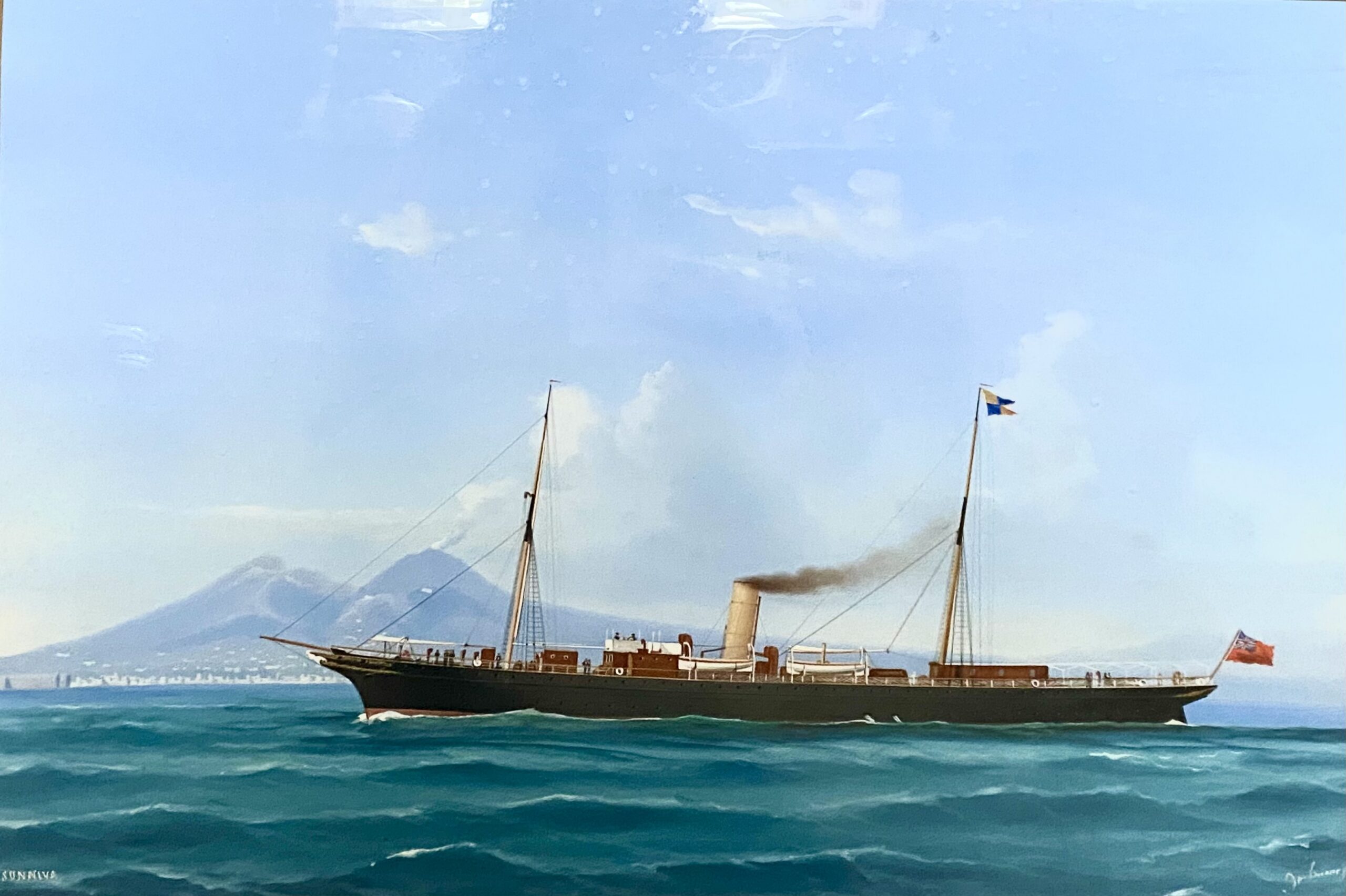
Watercolour of the Saint Sunniva
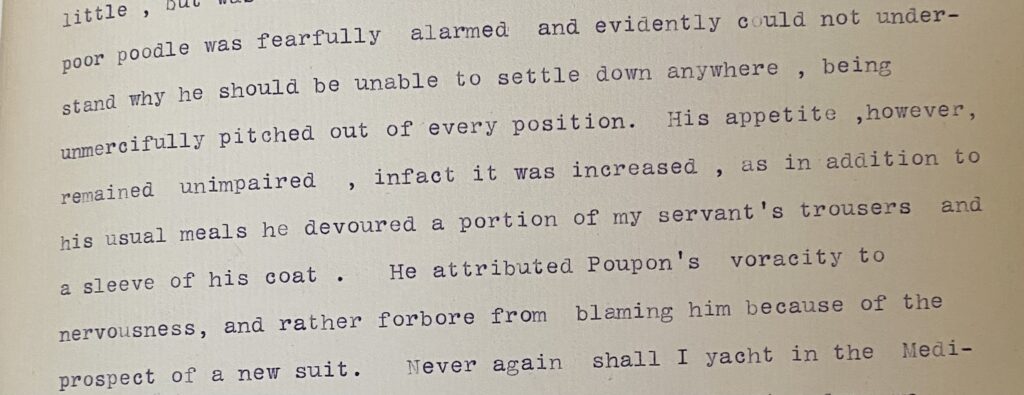
Extract from Ferdinand’s On Board the Saint Sunniva
Yachting: a family hobby
Ferdinand wasn’t the only member of the family to own a yacht. In fact, yachting was a major pastime for Ferdinand’s siblings Julie (1830-1907) and Nathaniel Mayer (1836-1905) and his cousin Edmond (1845-1934), among others. Julie’s Gitana was a 24-metre-long steam schooner commissioned in 1876 that earned her the title of ‘fastest yachting lady in the world’. Her outings were on Lake Geneva where she set yet another speed record in 1898 with the second schooner she commissioned, named Gitana II. The drawing below by Julie’s own hand is of her yacht against the beautiful waters and mountains of Lake Geneva.
Nathaniel was also an avid yachtsman, using his ship, the Veglia, in much the same way as Ferdinand. As an art collector, traveller and amateur photographer, he also sailed aboard two other yachts, the Aurora and the Thalia, heading for Livorno, Corsica, Algiers, Corfu, Greece and Turkey in 1893-4. He later had the photos privately printed and bound along with his written accounts in German, under the title Skizzen aus dem Süden (Sketches from the South). Their photographs, as seen below, are intriguing snapshots of local life, often with a staged and stylised view of its subjects. They show us how yachts were vessels of extraordinary decadence that offered a very particular way of encountering other cultures.
Edmond, the youngest child of James Mayer, the founder of the French branch of the family, owned a yacht called the Atmah, built in Glasgow in 1898, 290 feet in length and weighing around 1400 tons. The name comes from the Sanskrit word ‘Ātman’ referring to the innermost essence of a being. Perhaps this is telling of the Rothschild relationship to yachts. Shown below is the menu card for lunch aboard the Atmah which consisted of fried red mullet, a saddle of lamb and roasted pigeon, among other delicacies.
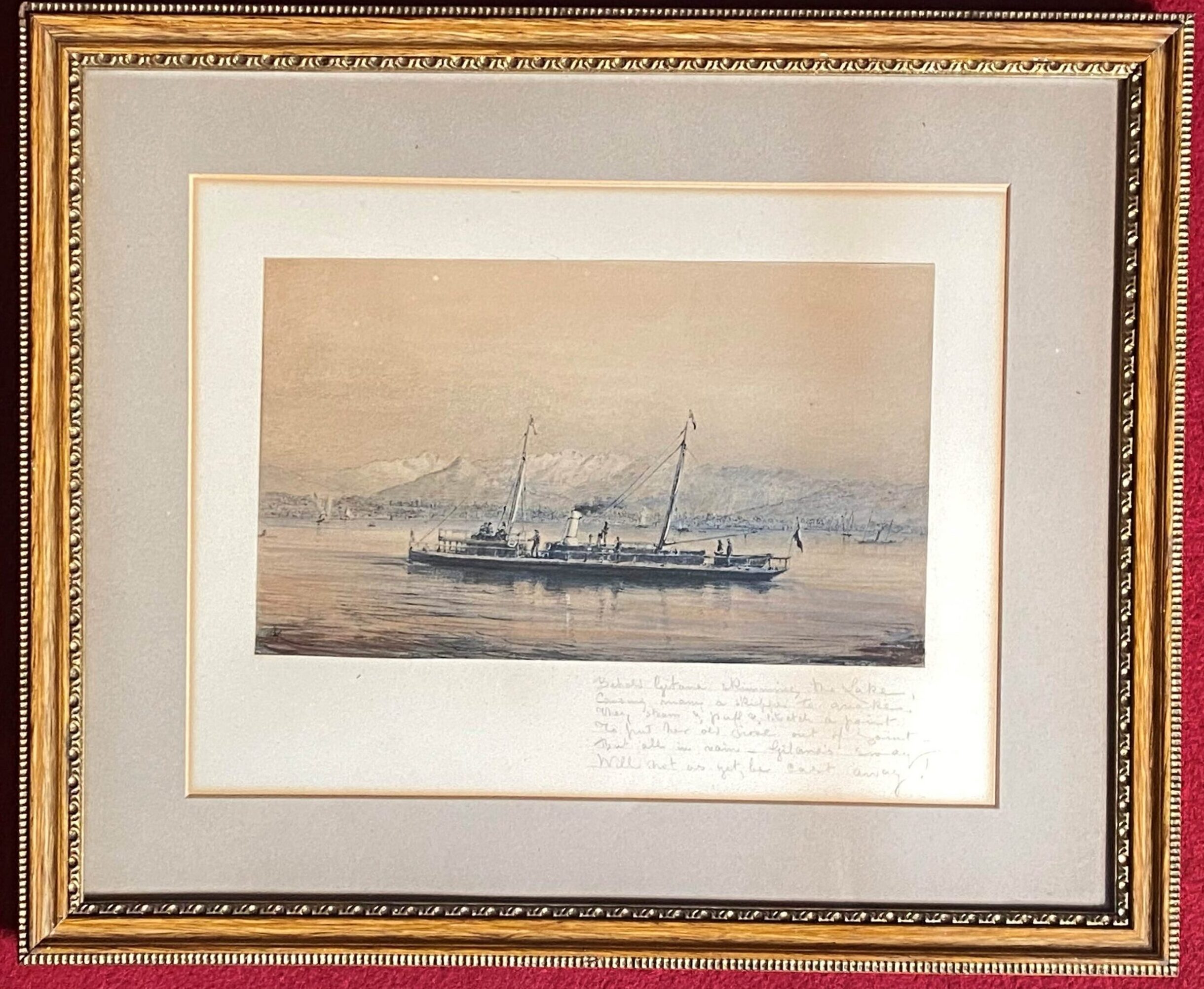
Drawing of Julie’s yacht, waterline model of the Rona
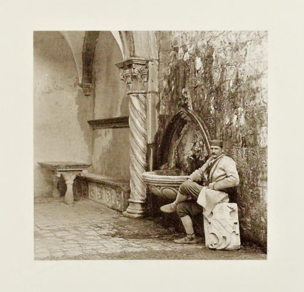
Im Hofe der Villa ‘Giorgio’ in Lapad Bei Ragusa
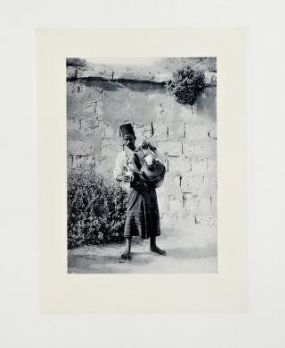
Ein Hemali (Cairo), A Hemali (Cairo)
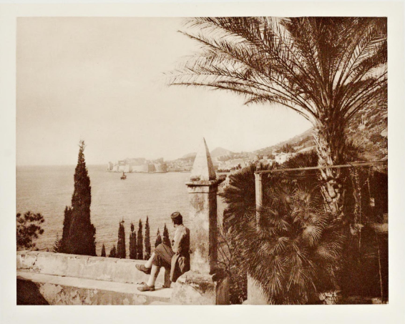
Bucht von Ragusa, Bay of Ragusa
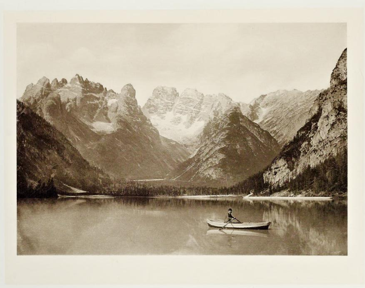
Monte Cristallo (Tirol), Mount Crystal, (Tirol)
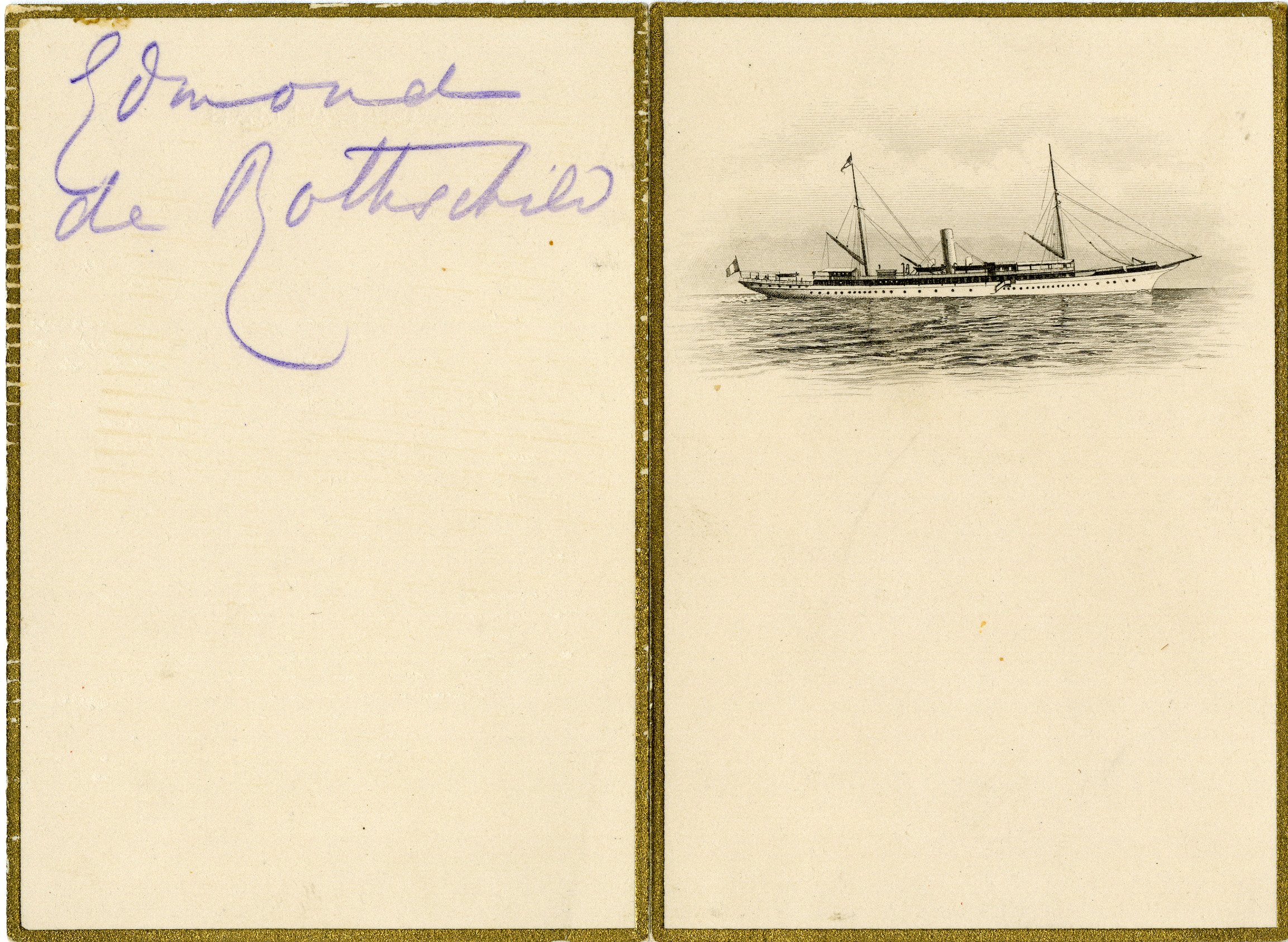
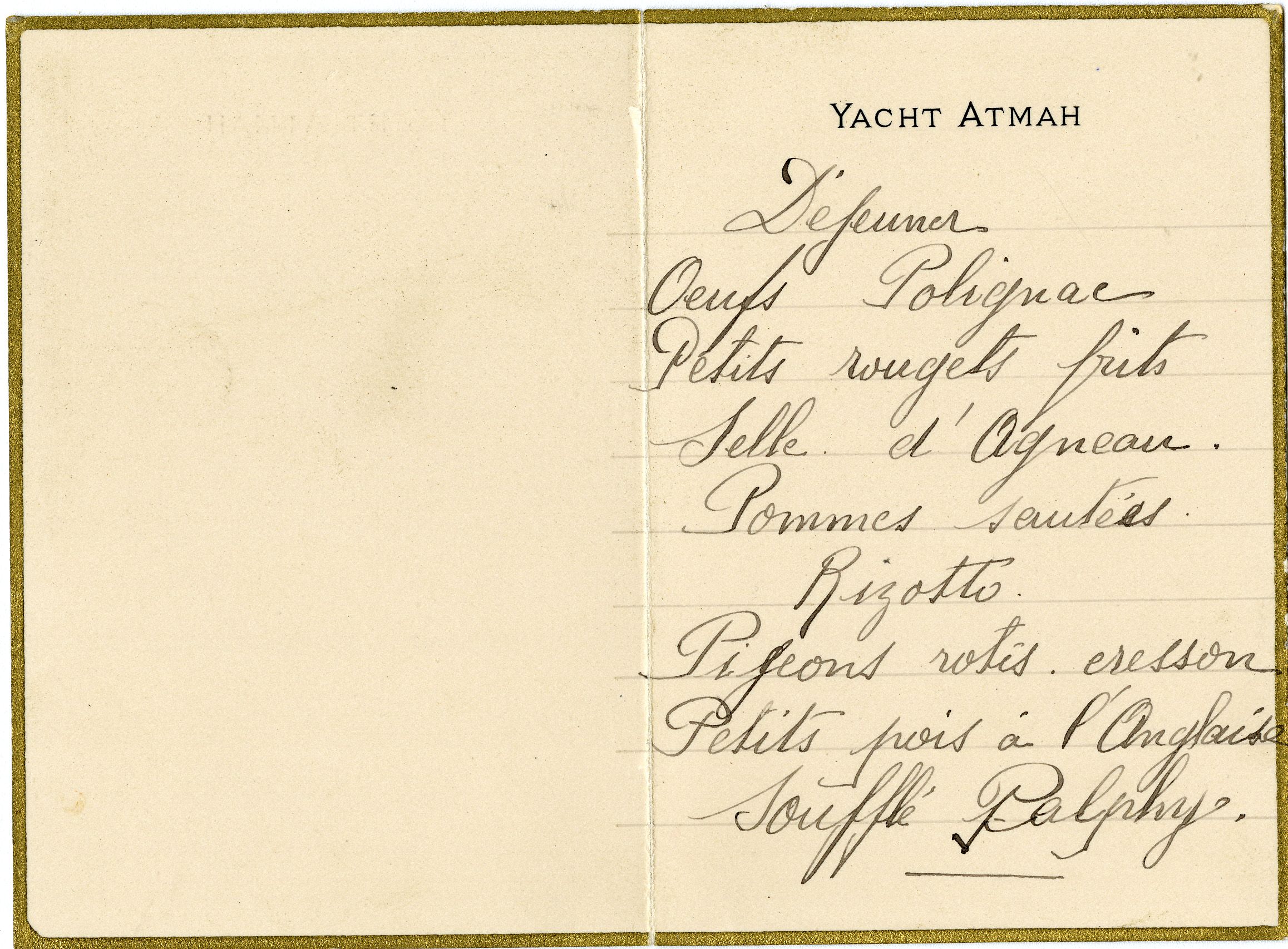
Menu card on TSY Atmah that reads, “Déjeuner. Oeufs Polignac. Petits rougets frits. Selle d’Agneau. Pommes sautées. Rizotto. Pigeons rotis. cresson. Petits pois à l’Anglaise. Soufflé Palphy”.
Rona steamship model conservation
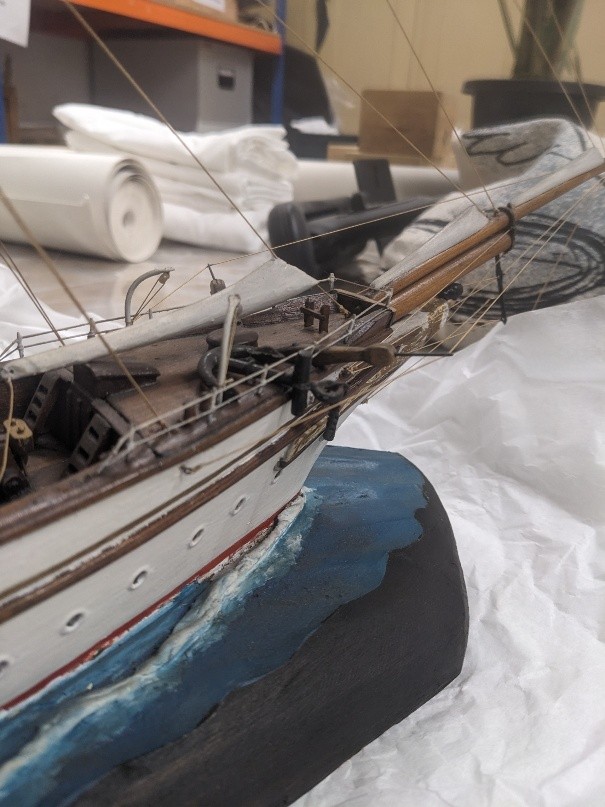
At Waddesdon Manor this Christmas, we have a model of Ferdinand’s Rona on display in the White Drawing Room. Our Heritage Conservation intern, Rosie Jones, tells us a bit about the conservation and display of the sailor’s waterline model of the Rona:
The waterline model whose maker is unknown, dates back to 1895 and has been removed from storage for display over the Christmas period, having undergone conservation cleaning in preparation. The Rona was dusted with a pony-hair brush, with a hoover held close to stop any dust being redistributed on the model. A pony-hair brush is used for its softness, and because the naturally curved ends are more sympathetic than the cut ends of synthetic fibres. Cleaning the model was a delicate process due to its small scale and astounding detail. The model includes, for example, sails and rigging, port holes, lifeboats, and two tiny anchors, one at rest on deck and one suspended over the side. The model even has a figurehead on its bow, and flies a tiny version of the ‘white ensign’, a naval flag flown by the Royal Navy and members of the Royal Yacht Squadron.
Since the last time it was cleaned, dust had collected in every crevice, and cobwebs had appeared on the rigging. The pony-hair brush worked to disturb and remove dust and cobwebs, leaving the Rona shipshape once more.
Images:
Rona Photograph Albums, 1897 (134.1997.2/3/4, 1103.1995)
Photograph of Milicent, Duchess of Sutherland (3706)
Francesco Simoni, watercolour of the St. Sunniva in the Bay of Naples, 19th century (126.1995)
Ferdinand de Rothschild, On Board the “Saint Sunniva”, 1893-4 (85.2025)
Julie Von Rothschild, drawing of the boat “Gitana”, 1880-85 (1244.1995)
Nathaniel Mayer Rothschild, Skizzen aus dem Süden, 2 volumes, 1894-5 (59.2018.1/2)
Menu card for lunch on TSY Atmah, 1890s (97.2005.24.4)
Model of the Rona, photographs taken by Rosie Jones